
Thinking Things Over
Why have we lost every war since 1945?


“Our responsibility to history is already clear: to answer these attacks and rid the world of evil.”
– President George W. Bush to Congress, September 14, 2001
“We will not permit the terrorists, these vicious and evil men, to hijack a peaceful religion and to impose their will on America and the world. We fight now, and we will keep on fighting until our victory is complete. We cannot know every turn this war will take. But I’m confident of the outcome. I believe in the strong resolve of the American people. I believe good triumphs over evil.”
– President George W. Bush to soldiers of the 101st Airborne deploying to Afghanistan, Fort Campbell, Kentucky, November 21, 2001
On January 13, 2003, Pope John Paul II told the Diplomatic Corps, “No to war! War is not always inevitable. It is always a defeat for humanity.”
On March 5, 2003, Cardinal Pio Laghi, the personal envoy of Pope John Paul II, visited the White House to conveyed to President Bush the pope’s message that his invasion and occupation of Iraq would cause “chaos” in the Middle East. “You might start, and you don’t know how to end it,” the cardinal later told the media.
Later reports from those attending the meeting indicated that the cardinal’s message may have received a less than dignified reception in the Oval Office. Nonetheless, the invasion began on March 19, 2003.
But there were problems. On March 7, 2003, Bishop John Botean, head of a small Byzantine Catholic diocese based in Ohio, had issued a pastoral letter warning those in his flock not to take part in the war, under pain of mortal sin. After a careful consideration of the Just War theory as explained in the Catholic Catechism, Bishop Botean concluded:
With moral certainty I say to you it [the Iraq War] does not meet even the minimal standards of the Catholic just war theory… I hereby authoritatively state that such direct participation is intrinsically and gravely evil and therefore absolutely forbidden.
When asked a month ago whether the U.S. war on Iran was legitimate, Timothy Broglio, president of the U.S. Conference of Catholic Bishops from 2022–2025 and head of the Archdiocese for the Military Services, replied, “Under the just war theory, it is not.”
He explained:
“It’s compensating for a threat before the threat is actually realized…. War is always a last resort.”
The stage was set for a moral debate that persists to this day.
Iraq, Iran, and the Catholic Conundrum
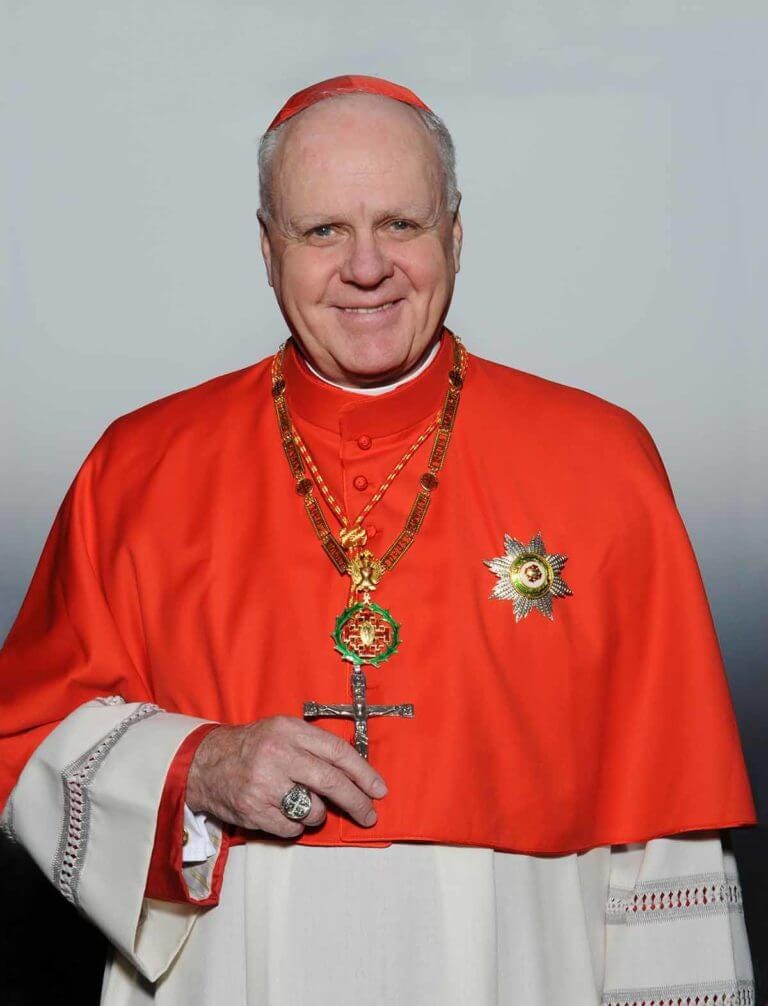
Catholic servicemen and women, wherever they serve, have their own “diocese,” called the Military Ordinariate. Eighteen years ago, on the Feast of the Annunciation, the Ordinariate’s Archbishop, the Most Reverend Edwin F. O’Brien, addressed all the chaplains under his command worldwide in a pastoral letter.
The letter offers a fascinating insight to the war.
Archbishop O’Brien addressed the issue directly – sort of. He told his priests that they could comfort those in combat units under their pastoral care who might be troubled in conscience thus:
Given the complexity of factors involved, many of which understandably remain confidential, it is altogether appropriate for members of our armed forces to presume the integrity of our leadership and its judgments and therefore to carry out their military duties in good conscience.
Archbishop O’Brien continued:
Long after the hostilities cease the debate likely will continue as to the moral justification for the armed force recently initiated by the United States and its allies. It is to be hoped that all factors which have led to our intervention will eventually be made public and that the full picture of the Iraqi regime’s weaponry and brutality will shed helpful light upon our President’s decision.
Archbishop O’Brien’s letter was careful not to endorse the war, or to indulge in the patriotic rhetoric that James Cardinal Gibbons had employed in 1917 to urge Catholics to enlist in World War I. Instead, the archbishop pointed to the abiding secrecy surrounding the genesis of the war and its conduct. Many “complex factors” contributed to the war policy. We have yet to hear the whole story, he wrote.
Archbishop O’Brien is not talking here about secret troop movements and other battlefield arrangements. Rather, he is addressing the unspoken reasons that caused the country to go to war in the first place. They had not been revealed by the war’s advocates.
Well, not yet. “The debate likely will continue” – indeed, it cannot end – until “all factors which have led to our intervention [are] made public,” he wrote. Only then will we know the truth about the “integrity of our leadership.”
Archbishop O’Brien was hopeful, but he didn’t appear to be holding his breath. He made it clear that, while US servicemen might enter the battle with a clear conscience, their leaders have a greater burden to bear. If they have lied, the powerful who have broken the commandments of God and sent men and women in harm’s way to fulfill their own venal designs will face Our Lord at a moment of His own choosing. Then everything that is hidden will be revealed. The punishment for the unrepentant will be harrowing, and eternal. That is why we pray for our nation’s leaders at every Mass – because the temptations of power are so great, and the punishment for its abuse is so severe.
Are We There Yet?
On October 9, 2004, Archbishop O’Brien traveled to Front Royal, Virginia to dedicate the beautiful St. John the Evangelist Library at Christendom College. In a reception attended by some 400 people, I had the opportunity to speak with him briefly. He listened intently, perhaps because I had hung a makeshift sign around my neck: “I’m sorry, I have laryngitis.” He charitably allowed me to struggle through a question.
“Your Excellency,” I croaked, “in March of last year you wrote that, when all factors which led to our intervention in Iraq were made public, we would be able to judge the president’s decision to go to war. Do we know enough today to make that moral judgment?”
The archbishop nodded in encouragement as I whispered. The group surrounding us grew quiet as he pondered his answer.
After a long, silent pause, he sighed, smiled, and raised his eyes towards the ceiling. That was all.
And Now What?
War is Hell. Its first victim is truth, Smedley Butler told us long ago. So we want to put it behind us – or at least put it out of our mind. “Look forward, never backward,” the “Success Life Coach” tells his clients. And there is so much we want to forget.
Well, we can’t do that.
Titus Livy, the Roman historian, suggests that the historian “trace the process of our moral decline, to watch first the sinking of the foundations of morality as the old teaching was allowed to lapse, then the final collapse of the whole edifice, and the dark dawning of our modern day when we can neither endure our vices nor face the remedies needed to cure them.”
If we tried to present a list of questions addressing “all the factors involved,” in America’s various military interventions, a lifetime would not be enough. But we have to learn from this. We have to sort it out, to understand the errors of the past, so as not to repeat them.
Twenty years ago, we didn’t sort it out. G.W. Bush didn’t “put an end to evil,” he gave us Speaker Nancy Pelosi’s Democrat majority in Congress in 2006 and Barack Obama in 2008.
Eight years later Americans repudiated the whole lot of them. Donald Trump was “America First” – “I’m not going to start wars, I’m going to stop wars,” he said on election night 2024.
But he just started another one.
The chaos we now experience hasn’t happened in a vacuum. This 25-years-long passion for war hasn’t only taken place half a world away. It’s been going on right here.
And it’s here that we’ll have to deal with it.
As always, your comments are worth reading and I look forward to them. I do think Bush's "hijacking
a peaceful religion," if he was referring to Islam is naive and ignorant at best. It would be so salutary for all of those who believe they're qualified to tell those who have been endorsed by a legitimate election to allowed those elected to do their jobs. I am, I hope and pray, a serious and practicing Catholic, unlike those who were recently in office. To honor the Pope is my intent. But why don't we let the President and his advisors do the driving and request the malicious purveyors of false news, et al. as well as his Holiness be silent for a change. They only cause distress and division.
"The crusader State."